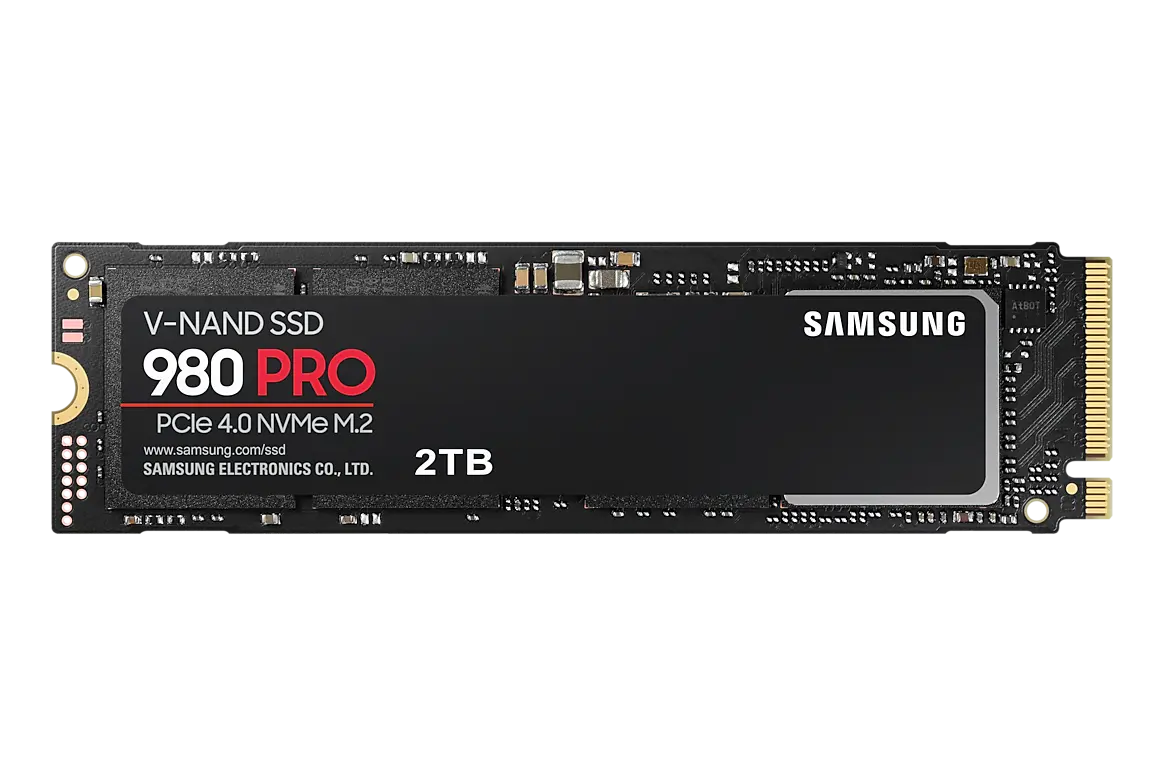
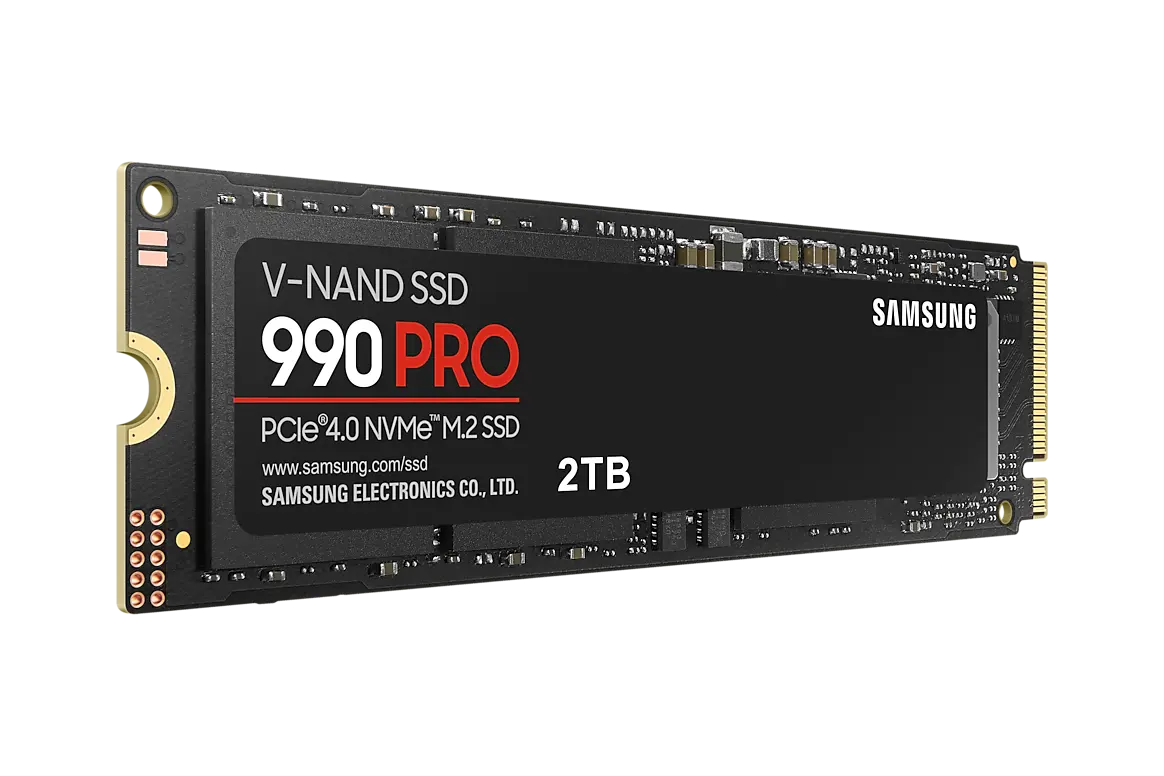
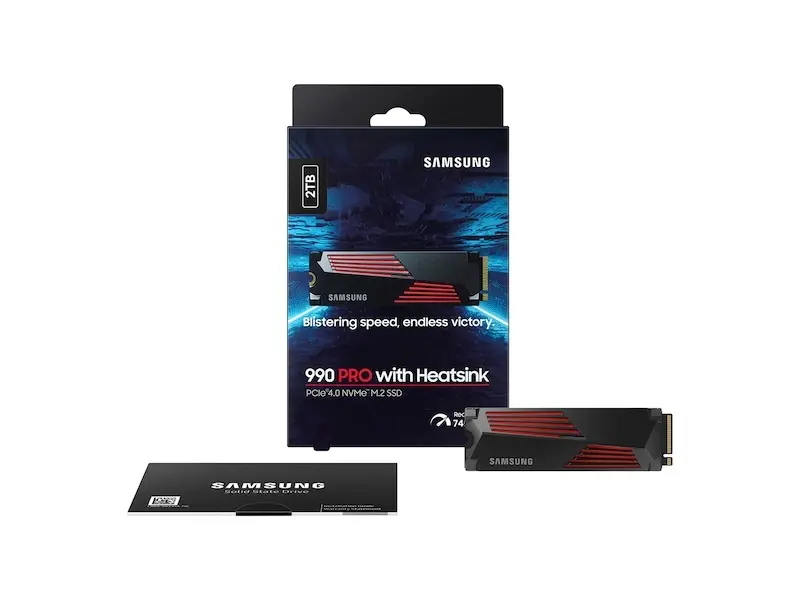
A 2 TB PCIe 4.0 NVMe SSD rated up to 7,000 MB/s read and 5,100 MB/s write, with TLC V-NAND, 2 GB LPDDR4 cache and a 1,200 TB write rating. It has no factory heatsink.
Specifications checked 11 Sept 2026.
Amazon links open search results. Check the exact variant, current price and availability with the retailer.
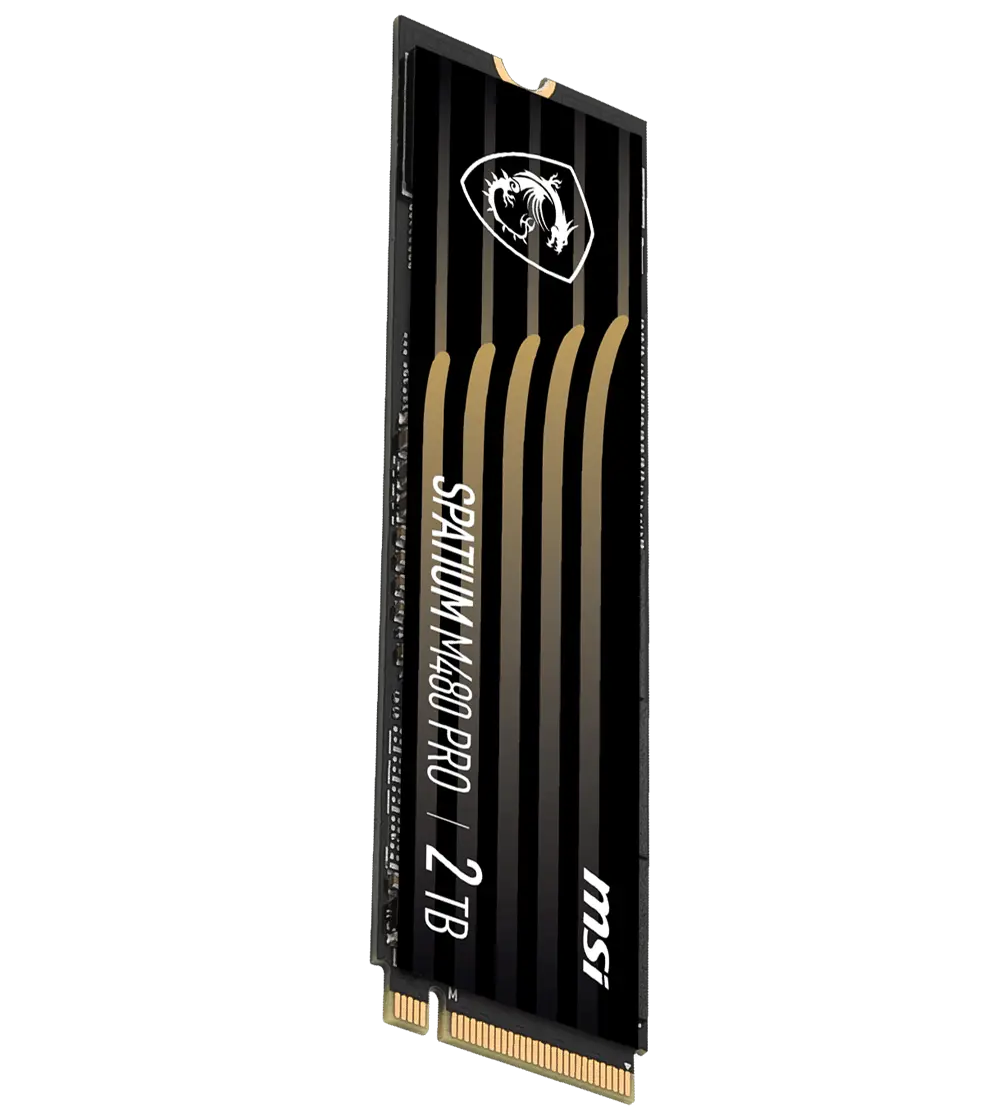
MSI's SPATIUM M480 PRO is a PCIe 4.0 x4 NVMe 1.4 SSD in a 2.15 mm M.2 2280 module. The 2 TB version is rated up to 7,400 MB/s read and 7,000 MB/s write, uses a Phison E18 controller with 2 GB of DDR4 cache, and has a 5-year or 1,400 TB limited warranty.
Specifications checked 27 Sept 2026.
Amazon links open search results. Check the exact variant, current price and availability with the retailer.
Search links open retailer results, not a matched listing; eBay listings are checked daily. As an Amazon Associate I earn from qualifying purchases. As an eBay Partner, we may be compensated if you make a purchase.
THE DIFFERENCES, MADE VISIBLE
Visual facts
Differences first. Select a topic for its graphic, sources and conditions.
How to read this comparison
Manufacturer facts for the exact models shown. Not a quality rating or a test result.
“Different” means the known values differ, not that one is better.
Missing or conflicting evidence is marked and never counts as a difference. Source chips hold each fact’s sources and conditions.
SPECIFICATIONS SIDE BY SIDE8 topics
SELECTED TOPIC
01 / 08
Write rating
The manufacturer’s published total-write rating. Read each drive’s workload and warranty conditions below: a TBW rating is not always the warranty cutoff. It is not a predicted failure point or reliability score.
Samsung 980 PRO1,200 TB
Manufacturer specification · Capacity-specific warranty write threshold, not a guaranteed failure point.
Manufacturer specification · 2 TB value (1 TB: 700; 4 TB: 3000); not a guaranteed failure point. The data sheet lists 1TB, 2TB and 4TB columns in that order; the 2TB value is the second column.
Check the connection before the capacity. M.2 NVMe modules and 2.5-inch SATA drives are not interchangeable. Check the host’s protocol, slot or bay, power connection and clearance. Rated speeds use different test systems; we do not turn them into a speed score or overall winner.
Manufacturer specification · 2 TB value (1 TB: 700; 4 TB: 3000); not a guaranteed failure point. The data sheet lists 1TB, 2TB and 4TB columns in that order; the 2TB value is the second column.
Named Elpis on Samsung's UK technical page; the current PDF revision describes it only as a Samsung in-house controller. · Manufacturer specification · UK technical page names Elpis. The current PDF revision (2.1) describes it only as a Samsung in-house controller.
Manufacturer specification · Listed as 'AES256/Pyrite (Encryption, Data Security)'. Listed security capabilities do not mean encryption is enabled or supported by every host.
Listed encryption support does not mean it is enabled. Check the exact host, software and configuration requirements; no security certification is inferred.
Manufacturer specification · Manufacturer feature block lists monitoring and software/firmware updates. OS/version support and feature prerequisites require separate checking.
Check the software, operating-system and licence requirements. An available feature does not establish a measured speed improvement or support on every host.
Samsung 980 PROUp to 7000 MB/s sequential read; up to 5100 MB/s cached sequential write
MSI SPATIUM M480 PROUp to 7400 MB/s sequential read; up to 7000 MB/s sequential write
Sources
Samsung 980 PRO
Manufacturer specification · Samsung IOmeter 1.1.0 claims: Ryzen 9 3900X, ASUS X570 ROG Crosshair VIII Formula, Windows 10 Pro; secondary drive. The datasheet lists additional BIOS, memory and CPU settings used for the test. Writes use Intelligent TurboWrite; peak rates depend on firmware, host, workload and cache state.
Manufacturer specification · MSI up-to claims measured as a secondary drive on AMD Ryzen 9 7950X / MSI MEG X670E ACE / 32 GB DDR5-4800 / Windows 11 Pro 22H2 with CrystalDiskMark 8.04c, ATTO Disk Benchmark 4.01.0f1 and IOmeter 1.1.0. MSI does not list a post-cache write speed. The data sheet lists 1TB, 2TB and 4TB columns in that order; sequential read is a single 7400 MB/s value for all capacities, and the 2TB sequential write value is the second column (1TB: 6000; 4TB: 7000).
Manufacturer peak claims depend on cache state, host and workload. Queue depth and test systems must match before performance can be compared; these figures do not establish a faster everyday drive.
Manufacturer specification · Samsung IOmeter 1.1.0 claims: Ryzen 9 3900X, ASUS X570 ROG Crosshair VIII Formula, Windows 10 Pro; secondary drive. The datasheet lists additional BIOS, memory and CPU settings used for the test. Writes use Intelligent TurboWrite; peak rates depend on firmware, host, workload and cache state.
Manufacturer specification · MSI up-to claims measured as a secondary drive on AMD Ryzen 9 7950X / MSI MEG X670E ACE / 32 GB DDR5-4800 / Windows 11 Pro 22H2 with CrystalDiskMark 8.04c, ATTO Disk Benchmark 4.01.0f1 and IOmeter 1.1.0. MSI does not list a post-cache write speed.
Manufacturer peak claims depend on cache state, host and workload. Queue depth and test systems must match before performance can be compared; these figures do not establish a faster everyday drive.
Manufacturer specification · Samsung IOmeter 1.1.0 claims: Ryzen 9 3900X, ASUS X570 ROG Crosshair VIII Formula, Windows 10 Pro; secondary drive. The datasheet lists additional BIOS, memory and CPU settings used for the test. Writes use Intelligent TurboWrite; peak rates depend on firmware, host, workload and cache state.
Manufacturer specification · MSI up-to claims measured as a secondary drive on AMD Ryzen 9 7950X / MSI MEG X670E ACE / 32 GB DDR5-4800 / Windows 11 Pro 22H2 with CrystalDiskMark 8.04c, ATTO Disk Benchmark 4.01.0f1 and IOmeter 1.1.0. MSI does not list a post-cache write speed. The data sheet lists 1TB, 2TB and 4TB columns in that order; the 2TB value is the second column (1TB: 6000; 4TB: 7000).
Manufacturer peak claims depend on cache state, host and workload. Queue depth and test systems must match before performance can be compared; these figures do not establish a faster everyday drive.
Warranty terms and endurance if applicable
Samsung 980 PRO5 years or 1200 TB written, whichever comes first; limited-warranty terms apply
MSI SPATIUM M480 PRO5 years or 1400 TB written, whichever comes first; limited-warranty terms apply
Sources
Samsung 980 PRO
Manufacturer specification · Manufacturer coverage is subject to purchase eligibility and applicable terms. A used drive may have less coverage left.
Manufacturer specification · 2 TB column; APST (Autonomous Power State Transition) supported. Measured on MSI's stated test system; not a constant everyday load. The data sheet lists 1TB, 2TB and 4TB columns in that order; the 2TB maximum operating power (10.5 W) and PS3 idle (45 mW) are the second column (1TB: 9.5 W, 40 mW; 4TB: 11.3 W, 50 mW), while L1.2 is a single 3 mW value for all capacities.
Check the exact configuration and source conditions for your use.
Small physical differences (1)
Drive dimensions
Samsung 980 PRO80.15 × 22.15 × 2.38 mm
MSI SPATIUM M480 PRO80 × 22 × 2.15 mm
Sources
Samsung 980 PRO
Samsung lists these as maximum dimensions. This version has no factory heatsink. · Manufacturer specification · Manufacturer dimensions; confirm installation clearance.
Evidence is missing or conflicting on at least one side. This is not a verified difference.
Included cloning software
Samsung 980 PRONot verified
MSI SPATIUM M480 PRONot verified
Sources
Samsung 980 PRO
Samsung does not state this for this model. · Manufacturer specification · Samsung does not list a bundled cloning tool for this model. Magician health monitoring and firmware updates alone do not confirm migration support.
Evidence is missing or conflicting on at least one side. This is not a verified difference.
Rated random read, QD1
Samsung 980 PRO22000 IOPS
MSI SPATIUM M480 PRONot verified
Sources
Samsung 980 PRO
Manufacturer specification · Up-to QD1 / one-thread value for this capacity under the manufacturer performance test setup. Not measured application latency.
Evidence is missing or conflicting on at least one side. This is not a verified difference.
Rated random write, QD1
Samsung 980 PRO60000 IOPS
MSI SPATIUM M480 PRONot verified
Sources
Samsung 980 PRO
Manufacturer specification · Up-to QD1 / one-thread 60000 IOPS for this 2 TB capacity with Intelligent TurboWrite under the stated modified Ryzen/ASUS test setup. Not application latency.
Evidence is missing or conflicting on at least one side. This is not a verified difference.
Device sleep support
Samsung 980 PROYes
MSI SPATIUM M480 PRONot verified
Sources
Samsung 980 PRO
Manufacturer specification · The UK page supports device sleep. Host support is required; device sleep is not the same as Modern Standby and gives no battery-life figure.
Evidence is missing or conflicting on at least one side. This is not a verified difference.
Rated performance on PCIe 3.0
Samsung 980 PROUp to 3500/3470 MB/s sequential read/write; 680000/630000 IOPS random read/write
MSI SPATIUM M480 PRONot verified
Sources
Samsung 980 PRO
Manufacturer specification · 2 TB backward-compatible mode in PDF footnote 2. Not the PCIe 4.0 peak figures or the 1 TB/250 GB values. Same manufacturer TurboWrite/test qualifications; actual host may differ.
Evidence is missing or conflicting on at least one side. This is not a verified difference.
Published system-level power
Samsung 980 PRO6.1 W average; 7.2 W maximum in burst mode
MSI SPATIUM M480 PRONot verified
Sources
Samsung 980 PRO
Manufacturer specification · The UK page labels a system-level average and a burst maximum. Hardware/configuration affect consumption. These are distinct from datasheet active read/write and idle/sleep states and are not a constant everyday load.
Samsung lists these as maximum dimensions. This version has no factory heatsink. · Manufacturer specification · Manufacturer dimensions; confirm installation clearance.
Manufacturer specification · Samsung IOmeter 1.1.0 claims: Ryzen 9 3900X, ASUS X570 ROG Crosshair VIII Formula, Windows 10 Pro; secondary drive. The datasheet lists additional BIOS, memory and CPU settings used for the test. Writes use Intelligent TurboWrite; peak rates depend on firmware, host, workload and cache state.
Manufacturer specification · MSI up-to claims measured as a secondary drive on AMD Ryzen 9 7950X / MSI MEG X670E ACE / 32 GB DDR5-4800 / Windows 11 Pro 22H2 with CrystalDiskMark 8.04c, ATTO Disk Benchmark 4.01.0f1 and IOmeter 1.1.0. MSI does not list a post-cache write speed. The data sheet lists 1TB, 2TB and 4TB columns in that order; sequential read is a single 7400 MB/s value for all capacities, and the 2TB sequential write value is the second column (1TB: 6000; 4TB: 7000).
Up to 7000 MB/s sequential read; up to 5100 MB/s cached sequential write
Up to 7400 MB/s sequential read; up to 7000 MB/s sequential write
Rated sequential readDifferentSources
Samsung 980 PRO
Manufacturer specification · Samsung IOmeter 1.1.0 claims: Ryzen 9 3900X, ASUS X570 ROG Crosshair VIII Formula, Windows 10 Pro; secondary drive. The datasheet lists additional BIOS, memory and CPU settings used for the test. Writes use Intelligent TurboWrite; peak rates depend on firmware, host, workload and cache state.
Manufacturer specification · MSI up-to claims measured as a secondary drive on AMD Ryzen 9 7950X / MSI MEG X670E ACE / 32 GB DDR5-4800 / Windows 11 Pro 22H2 with CrystalDiskMark 8.04c, ATTO Disk Benchmark 4.01.0f1 and IOmeter 1.1.0. MSI does not list a post-cache write speed.
Manufacturer specification · Samsung IOmeter 1.1.0 claims: Ryzen 9 3900X, ASUS X570 ROG Crosshair VIII Formula, Windows 10 Pro; secondary drive. The datasheet lists additional BIOS, memory and CPU settings used for the test. Writes use Intelligent TurboWrite; peak rates depend on firmware, host, workload and cache state.
Manufacturer specification · MSI up-to claims measured as a secondary drive on AMD Ryzen 9 7950X / MSI MEG X670E ACE / 32 GB DDR5-4800 / Windows 11 Pro 22H2 with CrystalDiskMark 8.04c, ATTO Disk Benchmark 4.01.0f1 and IOmeter 1.1.0. MSI does not list a post-cache write speed. The data sheet lists 1TB, 2TB and 4TB columns in that order; the 2TB value is the second column (1TB: 6000; 4TB: 7000).
Manufacturer specification · Up to, 4 KB QD32 / 16 threads; IOmeter 1.1.0, Ryzen 9 3900X / ASUS X570 Crosshair VIII Formula, Windows 10 Pro, secondary drive. PDF lists altered BIOS, memory and CPU settings; writes require TurboWrite. Not directly comparable to a four-thread Intel test.
Manufacturer specification · MSI up-to 4 KB claim for 2 TB; queue depth not stated. The data sheet lists 1TB, 2TB and 4TB columns in that order; the 2TB value is the second column (1TB: 750,000; 4TB: 1,000,000).
Manufacturer specification · Up to, 4 KB QD32 / 16 threads; IOmeter 1.1.0, Ryzen 9 3900X / ASUS X570 Crosshair VIII Formula, Windows 10 Pro, secondary drive. PDF lists altered BIOS, memory and CPU settings; writes require TurboWrite. Not directly comparable to a four-thread Intel test.
Manufacturer specification · Up-to QD1 / one-thread value for this capacity under the manufacturer performance test setup. Not measured application latency.
Manufacturer specification · Up-to QD1 / one-thread 60000 IOPS for this 2 TB capacity with Intelligent TurboWrite under the stated modified Ryzen/ASUS test setup. Not application latency.
Manufacturer specification · 2 TB backward-compatible mode in PDF footnote 2. Not the PCIe 4.0 peak figures or the 1 TB/250 GB values. Same manufacturer TurboWrite/test qualifications; actual host may differ.
Named Elpis on Samsung's UK technical page; the current PDF revision describes it only as a Samsung in-house controller. · Manufacturer specification · UK technical page names Elpis. The current PDF revision (2.1) describes it only as a Samsung in-house controller.
Manufacturer specification · 2 GB DDR4 for the 2 TB model (1 TB: 1 GB; 4 TB: 2 GB). The data sheet lists 1TB, 2TB and 4TB columns in that order; the 2TB value is the second column.
Manufacturer specification · 2 TB value (1 TB: 700; 4 TB: 3000); not a guaranteed failure point. The data sheet lists 1TB, 2TB and 4TB columns in that order; the 2TB value is the second column.
Manufacturer specification · Listed as 'AES256/Pyrite (Encryption, Data Security)'. Listed security capabilities do not mean encryption is enabled or supported by every host.
Manufacturer specification · Manufacturer feature block lists monitoring and software/firmware updates. OS/version support and feature prerequisites require separate checking.
Manufacturer specification · The UK page supports device sleep. Host support is required; device sleep is not the same as Modern Standby and gives no battery-life figure.
Manufacturer specification · 2 TB column; APST (Autonomous Power State Transition) supported. Measured on MSI's stated test system; not a constant everyday load. The data sheet lists 1TB, 2TB and 4TB columns in that order; the 2TB maximum operating power (10.5 W) and PS3 idle (45 mW) are the second column (1TB: 9.5 W, 40 mW; 4TB: 11.3 W, 50 mW), while L1.2 is a single 3 mW value for all capacities.
Manufacturer specification · The UK page labels a system-level average and a burst maximum. Hardware/configuration affect consumption. These are distinct from datasheet active read/write and idle/sleep states and are not a constant everyday load.
Show unverified (1)Not verified, not provided or conflicting for both products. Kept for completeness; never counted as a difference.
Specifications without verified values for either product
Included cloning softwareSources
Samsung 980 PRO
Samsung does not state this for this model. · Manufacturer specification · Samsung does not list a bundled cloning tool for this model. Magician health monitoring and firmware updates alone do not confirm migration support.
Each record represents an explicitly checked model and configuration. Original import: 5 Sept 2026; this is not its verification date. This is not a list of current offers or a popularity ranking.