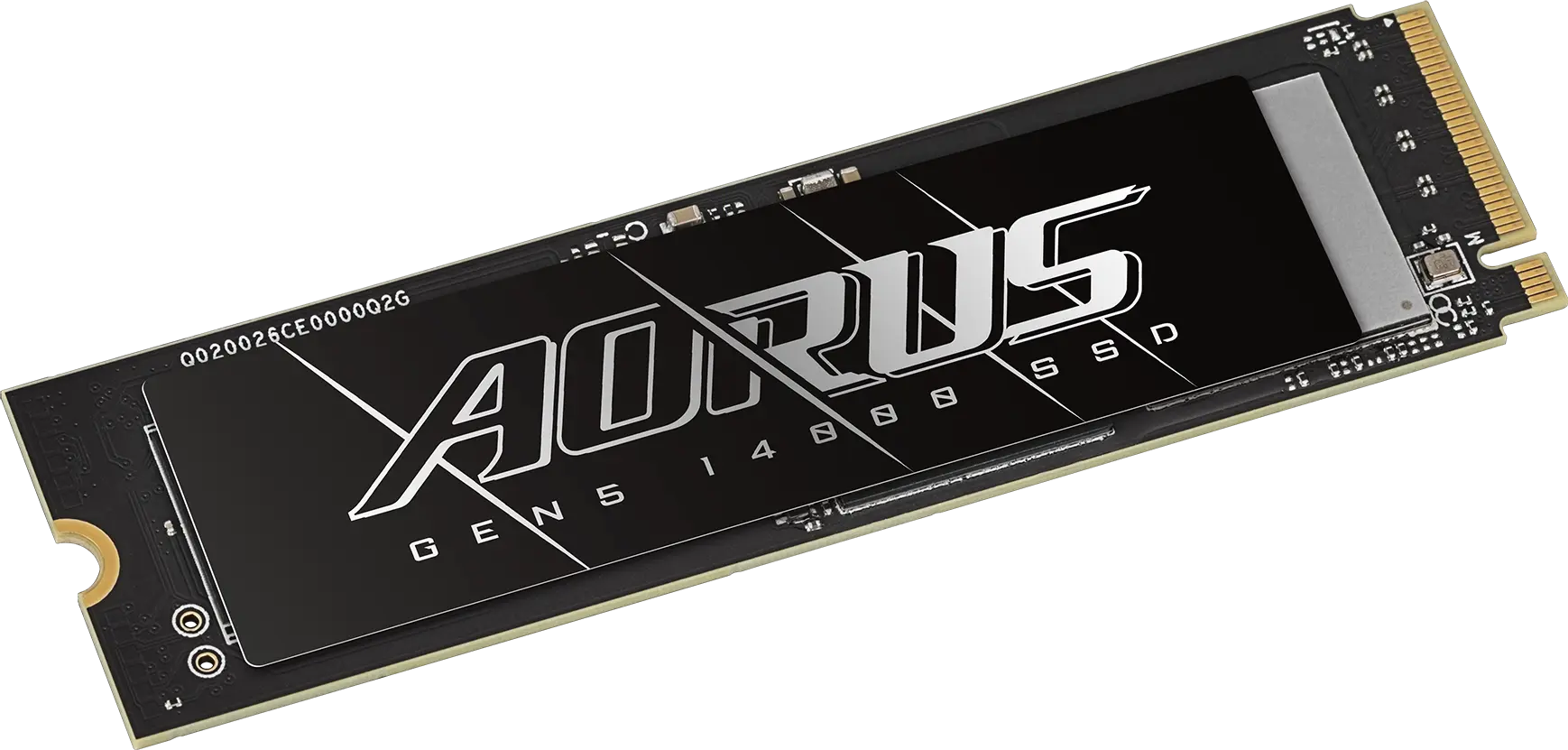
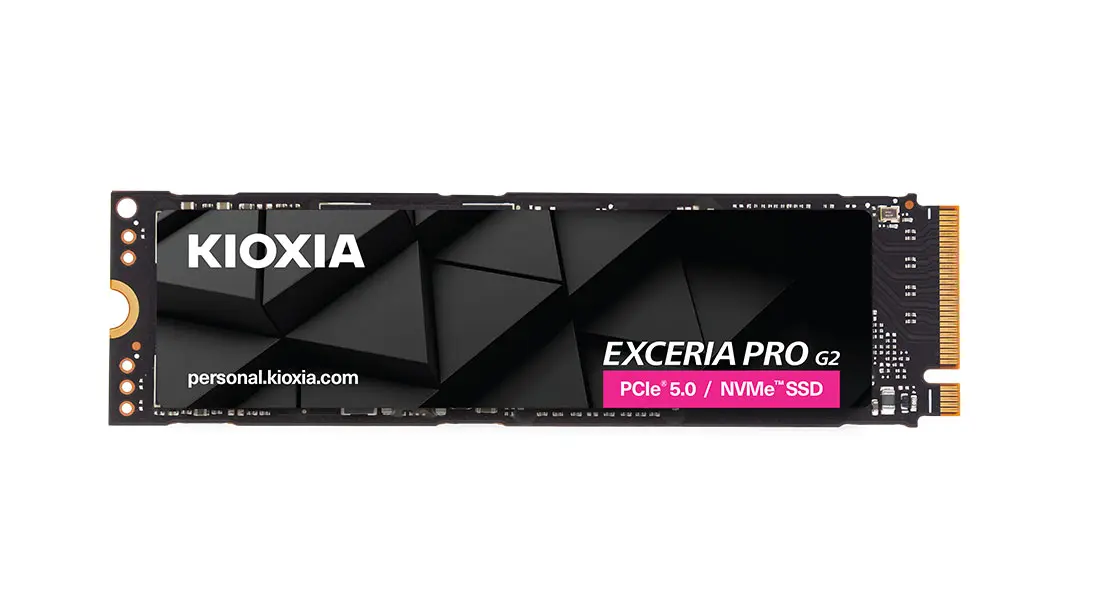
GIGABYTE's AORUS Gen5 14000 is a PCIe 5.0 x4 NVMe 2.0 SSD in a bare M.2 2280 module. The 2 TB version is rated up to 14,500 MB/s read and 12,700 MB/s write with a 1,400 TB warranty write threshold and a 5-year limited warranty, and GIGABYTE says it must be cooled by the motherboard's heatsink.
Specifications checked 27 Sept 2026.
Amazon links open search results. Check the exact variant, current price and availability with the retailer.
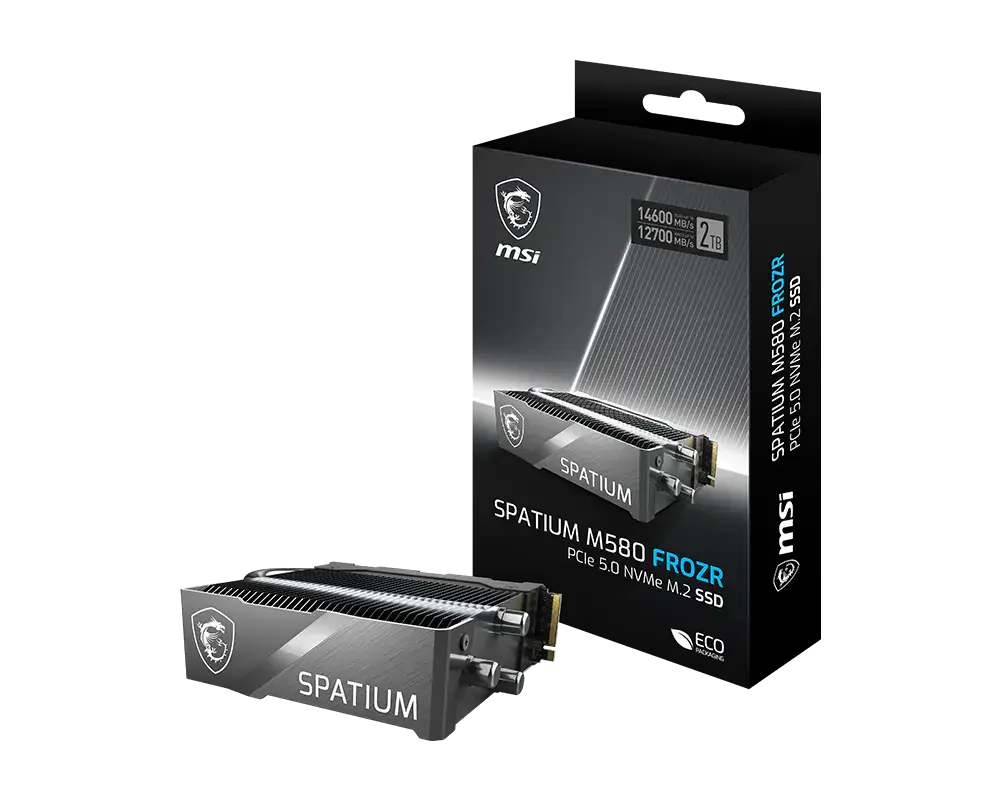
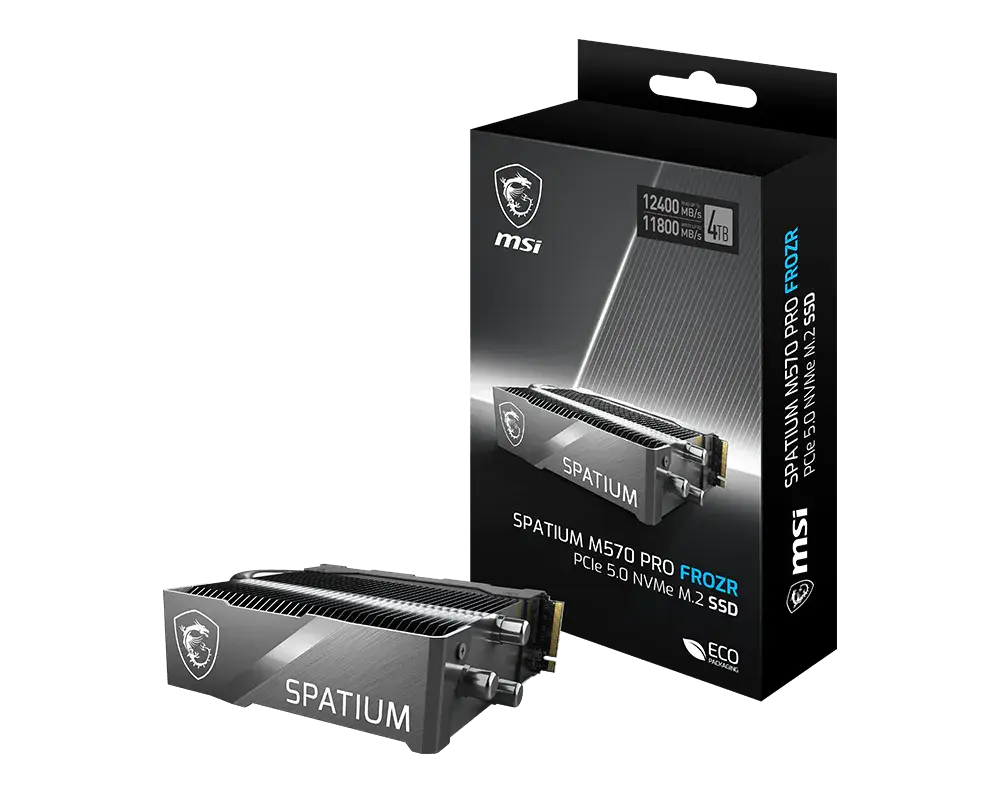
MSI's SPATIUM M580 FROZR is a PCIe 5.0 x4 NVMe 2.0 SSD sold with a towered FROZR heatpipe heatsink. The 2 TB version is rated up to 14,600 MB/s read and 12,700 MB/s write, uses a Phison E26 controller with 4 GB of LPDDR4 cache, and has a 5-year or 1,400 TB limited warranty.
Specifications checked 27 Sept 2026.
Amazon links open search results. Check the exact variant, current price and availability with the retailer.
Search links open retailer results, not a matched listing; eBay listings are checked daily. As an Amazon Associate I earn from qualifying purchases. As an eBay Partner, we may be compensated if you make a purchase.
THE DIFFERENCES, MADE VISIBLE
Visual facts
Differences first. Select a topic for its graphic, sources and conditions.
How to read this comparison
Manufacturer facts for the exact models shown. Not a quality rating or a test result.
“Different” means the known values differ, not that one is better.
Missing or conflicting evidence is marked and never counts as a difference. Source chips hold each fact’s sources and conditions.
SPECIFICATIONS SIDE BY SIDE8 topics
SELECTED TOPIC
01 / 08
Factory heatsink
Check the exact drive envelope and host cooling requirements. A factory heatsink can change clearance and removal restrictions; its presence alone does not prove faster sustained performance.
Gigabyte AORUS Gen5 14000No
Manufacturer specification · GIGABYTE says the drive must be used with the motherboard's built-in heatsink to prevent overheating and throttling; no heatsink is part of this model.
Manufacturer specification · Towered FROZR heatsink with Core Pipe heatpipes; MSI claims it reduces temperatures by up to 20 °C. That is a manufacturer claim, not a measured result here.
Check the connection before the capacity. M.2 NVMe modules and 2.5-inch SATA drives are not interchangeable. Check the host’s protocol, slot or bay, power connection and clearance. Rated speeds use different test systems; we do not turn them into a speed score or overall winner.
Manufacturer specification · GIGABYTE says the drive must be used with the motherboard's built-in heatsink to prevent overheating and throttling; no heatsink is part of this model.
Manufacturer specification · Towered FROZR heatsink with Core Pipe heatpipes; MSI claims it reduces temperatures by up to 20 °C. That is a manufacturer claim, not a measured result here.
Check the exact drive envelope and host cooling requirements. A factory heatsink can change clearance and removal restrictions; its presence alone does not prove faster sustained performance.
Manufacturer specification · GIGABYTE's warranty terms use the SMART page of 'GIGABYTE SSD toolbox' to show NVMe Percentage Used. The product overview also has a GIGABYTE Control Center (GCC) section describing GCC as unified software for GIGABYTE supported products; it lists no SSD-specific GCC functions.
Check the software, operating-system and licence requirements. An available feature does not establish a measured speed improvement or support on every host.
Gigabyte AORUS Gen5 14000Up to 14,500 MB/s sequential read; up to 12,700 MB/s sequential write
MSI SPATIUM M580 FROZRUp to 14,600 MB/s sequential read; up to 12,700 MB/s sequential write
Sources
Gigabyte AORUS Gen5 14000
Manufacturer specification · GIGABYTE internal testing with CrystalDiskMark and IOmeter 1.1.0; the test platform varies by model ('we will choose the latest platform for verification'). Firmware, host hardware and configuration affect results. GIGABYTE does not list a post-cache write speed.
Manufacturer specification · MSI up-to claims measured as a secondary drive on AMD Ryzen 9 7950X 16-Core Processor @4.50 GHz / MSI MPG X670E CARBON WIFI / Windows 11 Pro 23H2 OS Build 22631.2861, using CrystalDiskMark, ATTO Disk Benchmark and IOmeter. MSI does not list a post-cache write speed. The data sheet lists 1TB, 2TB and 4TB columns in that order; the 2TB values are the second column (sequential read 13,700/14,600/14,100 MB/s; sequential write 10,300/12,700/12,600 MB/s).
Manufacturer peak claims depend on cache state, host and workload. Queue depth and test systems must match before performance can be compared; these figures do not establish a faster everyday drive.
Manufacturer specification · GIGABYTE internal testing with CrystalDiskMark and IOmeter 1.1.0; the test platform varies by model ('we will choose the latest platform for verification'). Firmware, host hardware and configuration affect results. GIGABYTE does not list a post-cache write speed.
Manufacturer specification · MSI up-to claims measured as a secondary drive on AMD Ryzen 9 7950X 16-Core Processor @4.50 GHz / MSI MPG X670E CARBON WIFI / Windows 11 Pro 23H2 OS Build 22631.2861, using CrystalDiskMark, ATTO Disk Benchmark and IOmeter. MSI does not list a post-cache write speed.
Manufacturer peak claims depend on cache state, host and workload. Queue depth and test systems must match before performance can be compared; these figures do not establish a faster everyday drive.
Gigabyte AORUS Gen5 140005 years or 1400 TB written, whichever comes first; coverage also ends when NVMe 'Percentage Used' (SMART ID 05) in GIGABYTE SSD Toolbox reaches 100; limited-warranty terms apply
MSI SPATIUM M580 FROZR5 years or 1400 TB written, whichever comes first; limited-warranty terms apply
Sources
Gigabyte AORUS Gen5 14000
Manufacturer specification · TBW is evaluated by the JEDEC workload standard. GIGABYTE's specification page: a new unused drive shows a Percentage Used value of 0.
Gigabyte AORUS Gen5 1400011.5 W maximum operating (read and write); below 144 mW PS3 idle; below 85 mW PS4 (L1.2)
MSI SPATIUM M580 FROZR11.5 W maximum operating; 144 mW PS3 idle; 85 mW L1.2
Sources
Gigabyte AORUS Gen5 14000
Manufacturer specification · GIGABYTE's 2TB specification table lists 'Read : 11.5W; Write : 11.5W' maximum operating power and the PS3 and PS4 figures as upper bounds ('< 144mW', '< 85mW'); no test conditions are stated for these power figures.
Check the exact configuration and source conditions for your use.
Thermal design
Gigabyte AORUS Gen5 14000Requires the motherboard's built-in M.2 heatsink
MSI SPATIUM M580 FROZRTowered FROZR heatsink with Core Pipe heatpipes
Sources
Gigabyte AORUS Gen5 14000
Manufacturer specification · Manufacturer installation requirement to prevent throttling; no throttling or sustained-speed figures are published in the data sheet.
Manufacturer specification · GIGABYTE says the drive must be used with the motherboard's built-in heatsink to prevent overheating and throttling; no heatsink is part of this model.
Manufacturer specification · Towered FROZR heatsink with Core Pipe heatpipes; MSI claims it reduces temperatures by up to 20 °C. That is a manufacturer claim, not a measured result here.
Manufacturer specification · Manufacturer installation requirement to prevent throttling; no throttling or sustained-speed figures are published in the data sheet.
Manufacturer specification · GIGABYTE internal testing with CrystalDiskMark and IOmeter 1.1.0; the test platform varies by model ('we will choose the latest platform for verification'). Firmware, host hardware and configuration affect results. GIGABYTE does not list a post-cache write speed.
Manufacturer specification · MSI up-to claims measured as a secondary drive on AMD Ryzen 9 7950X 16-Core Processor @4.50 GHz / MSI MPG X670E CARBON WIFI / Windows 11 Pro 23H2 OS Build 22631.2861, using CrystalDiskMark, ATTO Disk Benchmark and IOmeter. MSI does not list a post-cache write speed. The data sheet lists 1TB, 2TB and 4TB columns in that order; the 2TB values are the second column (sequential read 13,700/14,600/14,100 MB/s; sequential write 10,300/12,700/12,600 MB/s).
Up to 14,500 MB/s sequential read; up to 12,700 MB/s sequential write
Up to 14,600 MB/s sequential read; up to 12,700 MB/s sequential write
Rated sequential readDifferentSources
Gigabyte AORUS Gen5 14000
Manufacturer specification · GIGABYTE internal testing with CrystalDiskMark and IOmeter 1.1.0; the test platform varies by model ('we will choose the latest platform for verification'). Firmware, host hardware and configuration affect results. GIGABYTE does not list a post-cache write speed.
Manufacturer specification · MSI up-to claims measured as a secondary drive on AMD Ryzen 9 7950X 16-Core Processor @4.50 GHz / MSI MPG X670E CARBON WIFI / Windows 11 Pro 23H2 OS Build 22631.2861, using CrystalDiskMark, ATTO Disk Benchmark and IOmeter. MSI does not list a post-cache write speed.
Manufacturer specification · 4 GB LPDDR4 for the 2 TB model (1 TB: 2 GB; 4 TB: 8 GB). The data sheet lists 1TB, 2TB and 4TB columns in that order; the 2TB value is the second column.
Warranty terms and endurance if applicableDifferentSources
Gigabyte AORUS Gen5 14000
Manufacturer specification · TBW is evaluated by the JEDEC workload standard. GIGABYTE's specification page: a new unused drive shows a Percentage Used value of 0.
5 years or 1400 TB written, whichever comes first; coverage also ends when NVMe 'Percentage Used' (SMART ID 05) in GIGABYTE SSD Toolbox reaches 100; limited-warranty terms apply
5 years or 1400 TB written, whichever comes first; limited-warranty terms apply
Limited warranty timeSources
Gigabyte AORUS Gen5 14000
Manufacturer specification · Time limit, not a lifespan prediction. Coverage also ends at the TBW threshold or when NVMe 'Percentage Used' (SMART ID 05) reaches 100; eligibility and full terms apply.
Manufacturer specification · Warranty write threshold for the 2 TB capacity (1 TB: 700 TB; 4 TB: 3000 TB), evaluated by the JEDEC workload standard; not a guaranteed failure point.
Manufacturer specification · 2 TB value (1 TB: 700; 4 TB: 3000); not a guaranteed failure point. The data sheet lists 1TB, 2TB and 4TB columns in that order; the 2TB value is the second column.
Manufacturer specification · GIGABYTE's warranty terms use the SMART page of 'GIGABYTE SSD toolbox' to show NVMe Percentage Used. The product overview also has a GIGABYTE Control Center (GCC) section describing GCC as unified software for GIGABYTE supported products; it lists no SSD-specific GCC functions.
Manufacturer specification · GIGABYTE's 2TB specification table lists 'Read : 11.5W; Write : 11.5W' maximum operating power and the PS3 and PS4 figures as upper bounds ('< 144mW', '< 85mW'); no test conditions are stated for these power figures.
Each record represents an explicitly checked model and configuration. Original import: 5 Sept 2026; this is not its verification date. This is not a list of current offers or a popularity ranking.